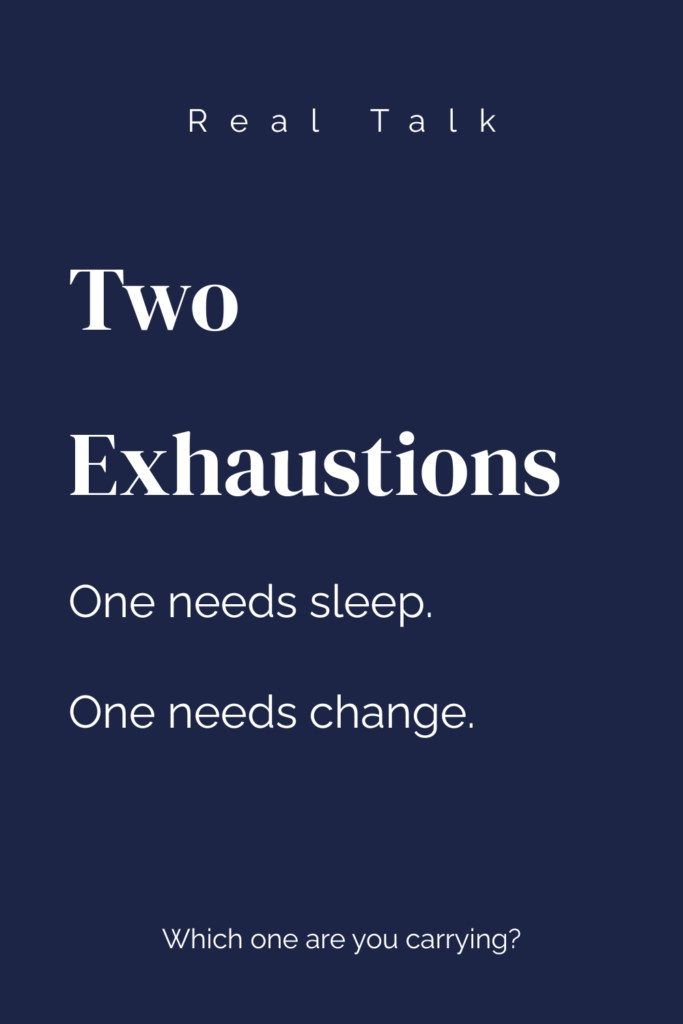
Two people can live in the same home and both feel exhausted for entirely different reasons, yet neither exhaustion is more valid than the other. One may carry the ongoing pressure of financial responsibility and the quiet weight of needing to remain steady. The other may carry the constant mental tracking of schedules, needs, and the invisible labor that keeps daily life moving.
Both are contributing. Both are stretched. Both are tired in ways the other does not always fully see.
This is not about effort or who is working harder. It is about capacity, and what happens over time when two people are each running low without recognizing that the other is too.
Exhaustion Outside the Home
Exhaustion outside the home often looks productive. It comes with deadlines, measurable outcomes, and visible strain that others can recognize and acknowledge. What is less visible is the steady awareness of bills, long-term stability, and responsibility that does not clock out at the end of the day.
When that weight follows you home, rest can begin to feel undeserved. Quiet moments become temporary rather than restorative, as if something is still unresolved and stillness has not yet been earned. The pressure does not always announce itself. It settles gradually, shaping the way a person moves through the evening, and lingers long after the workday has technically ended.
Exhaustion Inside the Home
Exhaustion inside the home rarely looks dramatic, yet it is constant in a way that is difficult to explain to someone who has not lived it. It shows up in the mental tabs that never fully close, in anticipating needs before they are spoken, and in quietly regulating the emotional tone of the household so that everyone else can function.
There is rarely a clear stopping point, and that absence of boundary carries its own weight. When the mental load never fully pauses, stillness becomes unfamiliar. True rest begins to feel just out of reach, even when the house is quiet and the day has technically wound down.
Married but Alone
When two different exhaustions live side by side, something subtle begins to shift. Conversations narrow to logistics. Gratitude quietly becomes assumed, and connection gets postponed. Not because love has disappeared, but because depletion narrows perspective.
It is possible to share a home and still feel alone in your exhaustion. Not abandoned. Not unloved. Just unseen in the depth of what you are carrying.
Over time, effort can start to feel transactional. Both are giving from different wells, and both are running low. Neither feels fully restored.
Why Travel Reset Matters
A travel reset is not escape from responsibility. It is an interruption of environment. Stepping outside the daily setting allows the nervous system to shift. Distance from routine creates clarity that is difficult to access while immersed in constant demand.
For the working parent, a short trip can create space away from performance pressure and the steady awareness of financial responsibility. For the stay-at-home parent, a change of environment can quiet the mental tracking that rarely stops, offering a stillness the home itself does not always allow.
When only one parent resets, imbalance quietly takes root. When neither does, exhaustion compounds over time and the distance between two people can grow without either fully understanding why. Reset is not a luxury reserved for one role or the other. It is maintenance, and maintenance must happen on both sides of the same home.
Whether that looks like a solo trip to decompress or a shared experience that reconnects, the form matters less than the recognition that both people need restoration. That need does not disappear because life is busy or because the other person is also tired.
When Reset Begins at Home
Not every reset requires a plane ticket. Sometimes it begins with a simple shift in atmosphere, one that signals to both people that the day has paused and connection is allowed to return.
That might look like an evening free from decision-making and daily management. It does not have to be elaborate to be effective. What matters is that both people are present for it, rather than one person creating the conditions while the other remains elsewhere mentally.
Creating that shift together is what separates a quiet evening from a moment of restoration. When both people recognize the need and meet it at the same time, something small can carry more weight than it appears.
This is not about luxury or grand gestures. It is about restoring enough capacity to show up for each other again and understanding that the home itself can become a place of reset when both people choose to treat it that way.
Begin Here
If reset starts at home, start with something small.
Download the Reset Mode: Home Ritual and create space tonight.
[Download the Reset Mode Checklist]

Togetherness Requires Space
Two people. Two exhaustions. One home.
Take a moment to consider what you are carrying right now, and then consider what your spouse may be carrying that you do not fully see. Both of you are likely holding more than the other realizes, and that gap in visibility is often where distance quietly grows.
It is worth asking what a twenty-four hour reset would look like for each of you, whether that means separate time to decompress or shared space away from the routine that keeps you both in functional mode. There is no single right answer. What matters is that the question gets asked and that both people are included in the decision.
Reset is not selfish. It is structural. It is how two depleted people find their way back to each other rather than simply coexisting under the same roof.
Sometimes that begins before a trip is ever booked. It begins with an environment that invites pause, with a scent that softens the edge of the day, with a small shift in atmosphere that says this moment is not about managing responsibilities but about being present together. Maintenance does not always start with a destination. Sometimes it starts right here.
Alana
Creative Director | popINK Studios